
 Italiano
 Español
 Français
 Deutsch
 Nederlands
 Polski
 Português
 Português do Brasil
 Pусский
 日本語
日本語 简体中文
简体中文 한국어
한국어 Bahasa Indonesia
This is an independent website and it'is not affiliated with or endorsed by the Vatican Museums.


The Last Judgment
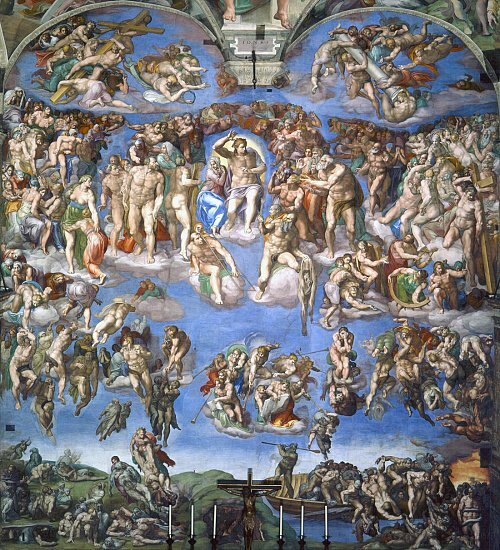
Michelangelo's altar wall
The Last Judgment fills the entire altar wall of the Sistine Chapel. Michelangelo painted it between 1536 and 1541, a quarter of a century after finishing the ceiling. Everything turns around the central figure of Christ, caught in the moment just before he gives the verdict. His raised hand both commands attention and seems to quiet the turmoil around him, starting a slow circular movement that draws every figure into the same rotation.
Right beside him is the Virgin Mary, who turns her face away. She can no longer step in; she can only wait for the outcome with everyone else. In the two upper lunettes, wingless angels carry the instruments of the Passion: the cross, the nails and the crown of thorns on one side, the column, the ladder and the lance on the other.
How to read the figures
The saints crowd around Christ and the Virgin, several of them holding the objects they were martyred with. St Peter carries his two keys, St Lawrence his gridiron, St Catherine of Alexandria her spiked wheel, and St Sebastian kneels with a handful of arrows. St Bartholomew holds up his own flayed skin, and the sagging face on that skin is usually read as a self-portrait of Michelangelo.
Lower down, angels blow long trumpets to wake the dead. On the left the risen climb back into their bodies and rise toward heaven; on the right angels and devils wrestle over the damned and drag them down. At the very bottom Charon swings his oar to drive souls out of his boat toward Minos, judge of the underworld, whose body is wound in a serpent. The whole lower corner borrows openly from the Inferno of Dante's Divine Comedy.
Scandal and the "breeches"
The fresco was admired and attacked in almost equal measure. The papal master of ceremonies Biagio da Cesena complained that so many nude bodies belonged in "stoves and taverns," not the Pope's chapel, so Michelangelo painted his face onto Minos down in hell. The argument dragged on for years.
In 1564 the Congregation of the Council of Trent ordered some of the nudes covered. The task of adding the painted draperies, the so-called braghe, went to Daniele da Volterra, known ever since as il Braghettone, the breeches-maker. His were only the first; more were added over the following centuries.