 Italiano
 Español
 Français
 Deutsch
 Nederlands
 Polski
 Português
 Português do Brasil
 Pусский
 日本語
日本語 简体中文
简体中文 한국어
한국어 Bahasa Indonesia
This is an independent website and it'is not affiliated with or endorsed by the Vatican Museums.


The Sistine Chapel
The Sistine Chapel
Why it's called the Sistine Chapel
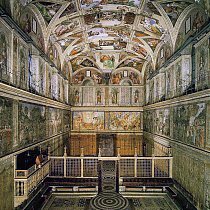
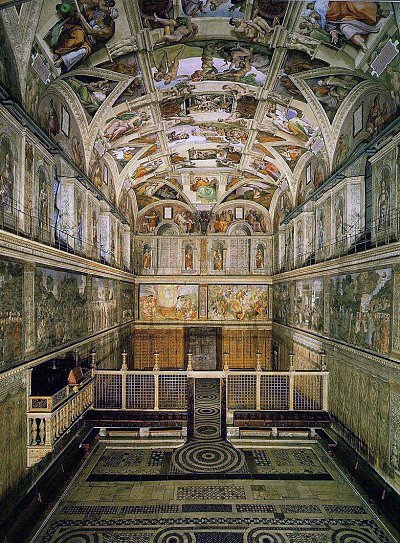
The chapel takes its name from Pope Sixtus IV della Rovere (pope from 1471 to 1484), who rebuilt the medieval Cappella Magna between 1477 and 1480. Its proportions follow the measurements the Old Testament gives for the Temple of Solomon, and the room has sat at the centre of Vatican life ever since. It is still where the cardinals shut themselves away in conclave to elect a new pope.
The 15th-century walls: Moses, Christ and the popes
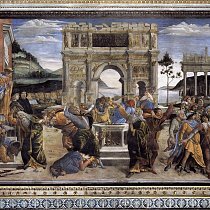
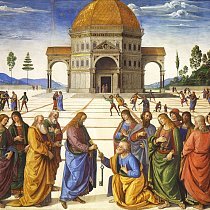
The first decoration came together quickly. A team of Florentine and Umbrian painters covered the side walls between 1481 and 1482 with three bands that still organise everything you see at eye level: painted drapery along the bottom, the Stories of Moses on the south wall and the Stories of Christ on the north, and a row of the earliest popes above. Pietro Perugino led the project, working with Sandro Botticelli, Domenico Ghirlandaio and Cosimo Rosselli, plus assistants including Luca Signorelli, Biagio di Antonio and Bartolomeo della Gatta. The ceiling, for the moment, was just a blue sky full of gold stars painted by Pier Matteo d'Amelia.
Sixtus IV consecrated the chapel on 15 August 1483 and dedicated it to the Assumption of the Virgin.
Michelangelo's ceiling, 1508 to 1512
Sixtus's nephew Julius II (pope 1503 to 1513) decided the starry sky was no longer enough. In 1508 he gave the ceiling to Michelangelo Buonarroti, who spent four years on the scaffolding and finished in October 1512. Julius II said the inaugural Mass on All Saints' Day, 1 November 1512.
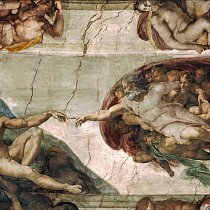
The nine central panels work through the Book of Genesis, from the Creation to the Flood and the family of Noah. Around them sit five Sibyls and seven Prophets on heavy thrones; the four corner pendentives show moments when Israel was saved from disaster; and the lunettes and spandrels are filled with the Ancestors of Christ.
The Last Judgment, 1536 to 1541
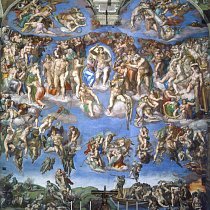
Michelangelo returned to the chapel two decades later, this time for the altar wall. Clement VII commissioned the Last Judgment late in 1533, and the painting went ahead under Paul III between 1536 and 1541. Making room for it meant destroying Perugino's altarpiece of the Virgin and the opening scenes of both 15th-century cycles. The fresco's nude figures drew objections almost at once, and after the Council of Trent some were covered with painted drapery by Daniele da Volterra, who picked up the nickname il Braghettone, "the breeches-maker", because of it.
The entrance wall and its repainting
The two scenes nearest the door are not the originals. Ghirlandaio's Resurrection of Christ and Signorelli's Dispute over the body of Moses were wrecked when the door's architrave fell in 1522, and they were repainted later in the century by Hendrik van den Broeck and Matteo da Lecce.
Restoration and visiting today
A full cleaning between 1979 and 1999 lifted centuries of soot and old varnish off the frescoes and brought back colours much brighter than most people had expected, reopening a long argument about how Michelangelo really worked. The marble screen, the singers' gallery and Sixtus IV's coat of arms were restored in the same campaign. The chapel is the last great room on the main Vatican Museums route, and photography is not allowed once you are inside.