
 Italiano
 Español
 Français
 Deutsch
 Nederlands
 Polski
 Português
 Português do Brasil
 Pусский
 日本語
日本語 简体中文
简体中文 한국어
한국어 Bahasa Indonesia
This is an independent website and it'is not affiliated with or endorsed by the Vatican Museums.


The North Wall: The Stories of Christ
The north wall: the life of Christ
The north wall carries the Stories of Christ, the New Testament half of the chapel's 15th-century decoration. Like the wall facing it, it is built in three layers: painted drapes along the bottom, the narrative scenes across the middle, and a row of early popes between the windows, with Michelangelo's Ancestors of Christ filling the lunettes above.
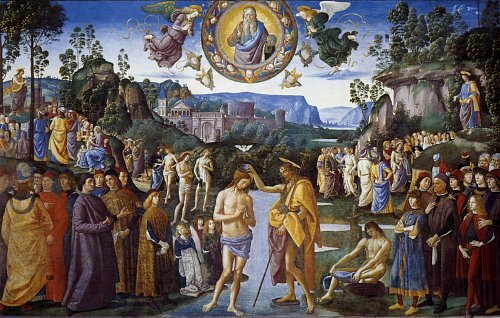
The cycle originally opened with a Nativity by Perugino on the altar wall. That panel was destroyed in the 1530s to clear space for the Last Judgment, so the story now starts with the Baptism of Christ and runs the length of the wall.
The Stories of Christ
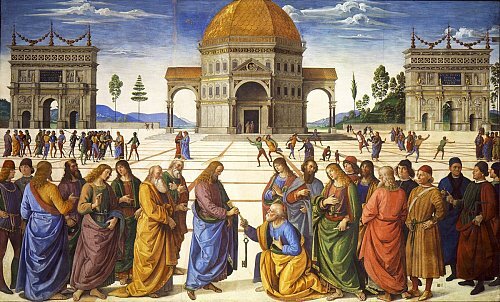
Six large panels survive, each from a different Florentine or Umbrian workshop. They run from the Baptism of Christ to the Temptations in the Desert, the Calling of the Apostles Peter and Andrew, the Sermon on the Mount with the healing of the leper, the Delivery of the Keys to Peter, and finally the Last Supper.
The painters crammed extra episodes into the backgrounds. Behind the Keys you can pick out the tribute money and an attempt to stone Christ; behind the Last Supper sit the Agony in the Garden, the Arrest and the Crucifixion. The sequence was always meant to end just around the corner, with the Resurrection on the entrance wall.

The Ancestors of Christ in the lunettes
Above the windows, in the lunettes and the curved spandrels beside them, Michelangelo painted the Ancestors of Christ, the family line the Gospel of Matthew traces from Abraham across forty generations. Luke's version, counting back to Adam, lists seventy-five. These are not formal portraits but groups of ordinary people: parents with children, figures lost in thought or asleep. The name-labels rarely match a single figure cleanly, so most of them cannot be identified with any confidence.
Portraits of the popes
Between the windows stand the early popes, painted in pairs in shallow niches by the same four workshops that produced the narrative scenes. The series once began on the altar wall, around figures of Christ and St Peter with Linus and Cletus beside them; those were lost in 1536 when Michelangelo took the wall for the Last Judgment. Each pope is shown almost full length, turned slightly to one side, holding a book or raising a hand in blessing.
The painted drapes
The lowest band imitates hanging tapestries. Each panel is a painted cloth, shaded to look like heavy gold-and-silver brocade hooked to the wall, and stamped with the della Rovere oak and the inscription Sixtus Papa IIII. From about 1520 this strip was meant to be covered on the great feast days by real tapestries, the celebrated set woven in Brussels from Raphael's cartoons showing scenes from the Acts of the Apostles.