
 Italiano
 Español
 Français
 Deutsch
 Nederlands
 Polski
 Português
 Português do Brasil
 Pусский
 日本語
日本語 简体中文
简体中文 한국어
한국어 Bahasa Indonesia
This is an independent website and it'is not affiliated with or endorsed by the Vatican Museums.


The Sistine Chapel Ceiling

Why Michelangelo painted the ceiling
The ceiling was not supposed to be Michelangelo's at all. Early in the reign of Julius II (1503 to 1513), the chapel ran into structural trouble: digging nearby for the Borgia Tower and the new St Peter's left the building unstable, and in May 1504 a long crack opened across the vault. Bramante, the palace architect, anchored it with iron tie-rods, but the old starry-sky ceiling had been damaged enough that Julius decided to replace it.
The first contract, signed on 8 May 1508, was modest: twelve apostles in the pendentives and decorative filler everywhere else. Michelangelo dismissed the plan as "a poor thing" and pushed for more. Julius gave him an almost free hand, and the artist, probably advised by theologians at the papal court, designed one of the most ambitious painting schemes ever attempted.
How the ceiling is organised
Down the spine of the vault run nine scenes from the Book of Genesis, set inside a painted architecture and flanked by the muscular nude youths known as the ignudi, who hold up bronze-coloured medallions. At the base of that framework sit twelve Prophets and Sibyls on thrones. Below them, in the spandrels and lunettes, are the Ancestors of Christ, while the four corner pendentives show moments when Israel was rescued from disaster. Michelangelo finished the first half, as far as the Creation of Eve, by August 1510, and completed the whole vault by 31 October 1512. Julius II celebrated Mass beneath it the following day.

The nine Genesis scenes
The nine central panels fall into three groups of three: the making of the world, the making of humankind, and the arrival of sin. The first three are dominated by the figure of God the Creator, with the Separation of Light from Darkness, the Creation of the Sun, Moon and Plants, and the Separation of Land from Sea.
The middle pair is the one everyone knows: the Creation of Adam, with the famous near-touching hands, and the Creation of Eve. Their nakedness stands for innocence, and that innocence is lost in the next panel, the Original Sin and Banishment from the Garden of Eden.
The last three turn to Noah: the Sacrifice of Noah, the Flood, and the Drunkenness of Noah. Read together they trace the fall of humanity and its second chance, since God spares Noah to repopulate the earth after deciding to destroy a corrupt world.

Prophets and Sibyls
Around the Genesis scenes, twelve seers sit on heavy marble thrones, prophets alternating with sibyls along the long sides. The two ends carry the most prominent figures: Zechariah near the entrance and Jonah above the altar. Jonah gets pride of place because the three days he spent inside the great fish were read as a foreshadowing of Christ's resurrection.
Each figure is named on a label beneath the throne. Mixing the two groups makes a theological point: the Hebrew prophets foretold a redeemer for Israel, while the pagan sibyls, the Delphic and Libyan among them, stretch that same expectation to the non-Jewish world. Together they stand for the whole of humanity waiting for salvation.
The corner pendentives
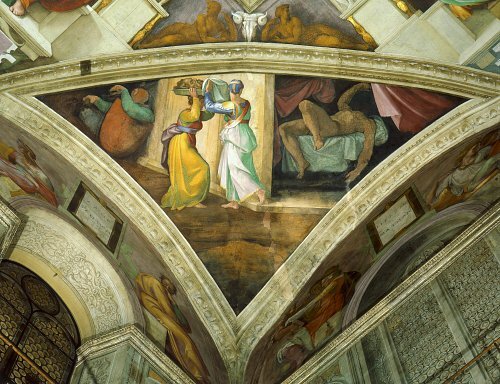
In the four corners, larger curved spandrels carry four scenes of Israel saved from destruction, among them Judith and Holofernes and the bronze serpent raised by Moses. Michelangelo treated these corners as hinges between the ceiling and the walls: each one shows God stepping in to rescue his people, which the programme reads as one more promise of the redemption to come.

The spandrels and the Ancestors of Christ
The eight smaller spandrels above the windows hold groups of figures that most likely continue the Ancestors of Christ begun in the lunettes below: families with children, waiting and resting in shadow. Scholars still argue over who is who, since the figures rarely line up neatly with their name-labels. The mood, though, is clear enough. These are ordinary human generations, the long line of descent that leads toward Christ.