
 Italiano
 Español
 Français
 Deutsch
 Nederlands
 Polski
 Português
 Português do Brasil
 Pусский
 日本語
日本語 简体中文
简体中文 한국어
한국어 Bahasa Indonesia
This is an independent website and it'is not affiliated with or endorsed by the Vatican Museums.


The Entrance Wall
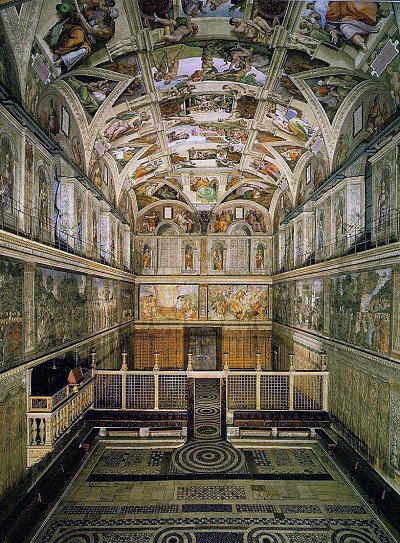
The entrance wall
The entrance wall, the one at your back as you face the altar, closes both narrative cycles at once. It holds the last scene of the Moses story and the last scene of the Christ story: the Resurrection of Christ and the Dispute over the body of Moses. As on the side walls, popes look down from above and painted drapes run along the bottom.
Neither fresco here is original. The first versions, by Ghirlandaio and Luca Signorelli, were destroyed in 1522 when the stone lintel over the door gave way. They were repainted later in the century, under Gregory XIII.
The Resurrection of Christ
The Resurrection of Christ that closes the New Testament cycle is the work of Hendrik van den Broeck, often Italianised as Arrigo Fiammingo, who replaced Ghirlandaio's lost original. It answers the Nativity that once stood on the altar wall, so the life of Christ both opened and closed at the two ends of the room.
The Dispute over the body of Moses
Facing it is the Dispute over the body of Moses, repainted by Matteo da Lecce after Signorelli's version was wrecked in the same 1522 accident. The subject comes from the short Letter of Jude and shows the archangel Michael contesting the devil for the prophet's body, bringing the Old Testament cycle to its close.