
 Italiano
 Español
 Français
 Deutsch
 Nederlands
 Polski
 Português
 Português do Brasil
 Pусский
 日本語
日本語 简体中文
简体中文 한국어
한국어 Bahasa Indonesia
This is an independent website and it'is not affiliated with or endorsed by the Vatican Museums.


Hollywood Stars Visit the Vatican: Cate Blanchett and Spike Lee Meet with the Pope
Storytellers and the Power of Cinema
Storytellers often say “once upon a time,” when introducing the story they will tell you. There are many creative artists and cinematographers who have so many stories waiting to be told. As a result of Pope Leo’s speech on the importance and beauty of films, along with the obligations of those who work in this medium, there were numerous acclaimed actors and filmmakers from all over the world who walked through the Apostolic Palace to relate their personal experiences with the papacy.
At the Core of the Community
By the year 2024, global cinema admissions decreased by 8.8%, which represents nearly half a billion tickets less than in 2023. There was a significant rise in the use of streaming apps leading to this decline as well. As Pope Leo commented on this decline, "Cinemas and theaters are the lifeblood of our communities." He stressed their importance for both cultural and societal reasons and urged all possible efforts to ensure their survival.
Sincerely accepting an actress's challenge can be tough. Leslie Mann found that to be true. Her ultimate goal would be motivating us (the audience) to come back and see movies at our theatres/cinemas, adding that At Home on Your Couch isn't a great way to experience movies together.
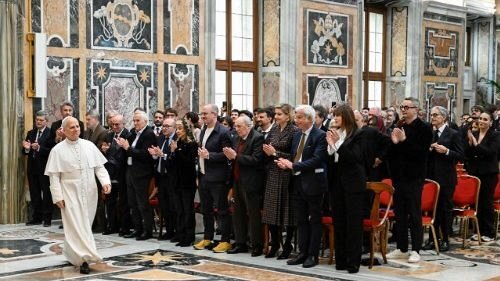 Pope: Cinema is more than a screen; it sets hope in action
Cinema Ignites Hope, Says the Pope
Mann has followed Pope Francis's invitation to be optimistic when thinking about the future: "We're very excited about the future of film and we're looking forward to it very much," she said. While the Pope spoke in Italian, Mann told Vatican News about how much he appreciated the people attending. "It was amazing," she said, and added that she will go home and get an English translation of her meeting with the Pope.
The Intersection of Religious Institutions and the Film Industry
Kenneth Lonergan, an American playwright, screenwriter, and director, shares this optimistic view of the role of the Church in promoting art, even though he doesn't personally identify with Christianity, Catholicism or any particular religion: "The Catholic Church has been one of the greatest supporters of art throughout its history."
Lonergan praised Pope Leo for his eagerness to add a new medium (cinema) into the family of arts. Lonergan believed that a world without any art — be it film, painting, or music — would be a very sad one to live in. In today's world of conflict and problems in society, art and cinema in particular have the potential to give people hope. “When people are given an opportunity for hope, they take it, and there is potential for such hope through art and cinema.”
He commented that it is an "enormous privilege" to be a part of creating (“behind-the-scenes”) film and to help provide evidence of beauty, truth and hope to those who seek entertainment or deeper meaning. Close to home. Once the Pope's remarks were complete, individual artists from various backgrounds were able to meet with him to present their gift if they wanted.
Spike Lee’s Gift to the Pope
The Pope’s gift has its roots in his time at Villanova University, and comes from Spike Lee, a filmmaker in Brooklyn, NY, who gave him a customized Knicks jersey. “I’ll tell you the story,” he said. “When the Pope was at Villanova University, he was there with three players from the New York Knicks who played at Villanova.”
The city edition jersey features the name of Pope Leo along with the number 14, serving as a tribute to his affiliation with his alma mater.
Film Serves as a Platform for Those Who Lack a Voice
The actress and film producer Cate Blanchett gave the Pope a simple blue bracelet with significant meaning. She explained, “I work with UNHCR (the United Nations Refugee Agency),” and added that it is a bracelet that she wears to show support for those who are displaced.
At the beginning of 2023, UNHCR’s Goodwill Ambassador Cate Blanchett opened the Displacement Film Fund to financially assist and support the film-making efforts of either filmmakers who are displaced or those with a track record of producing inspiring stories about the lived experience of displaced persons.
Noting that, in her opinion, the perspective of many of the refugee filmmakers have been ignored by the mainstream, Cate Blanchett stated this while working with Vanja Kaludjercic, Director of the International Film Festival Rotterdam. Therefore, she and Mr Kaludjercic felt that it was crucial to present the work of these filmmakers through the funding of this Fund to the Holy Father.
A Shared Commitment to Human Dignity
Kaludjercic insisted, in a major way, of how important his Holiness was to the launching of this forum on building relationships through dialogues and that it was necessary to create a venue for telling stories of people who are too often forgotten (e.g., displaced filmmakers). She argued that the very foundation of this initiative demonstrates that the Vatican and the displacement film fund share the same common values of promoting the basic human rights of all people, as well as the inherent dignity of every individual.
Today’s global society is facing considerable difficultly in meeting its humanitarian obligations due to the number of people who have been forcibly displaced. Recent estimates compiled by UNHCR indicate that at the end of June 2025, an estimated 117 million people had been displaced worldwide as a result of persecution, armed conflict, violence, violations of human rights or “events that seriously disrupt public order”.
This is a challenge we must face and cannot avoid. The need for anyone in the film industry to address ‘the world’s wounds’ has been stressed today by Pope Leo. Violence, poverty, exile, isolation, addiction and many forgotten wars all need to be recognised and told.
As Blanchett left the Pope's speech, she reflected on his message regarding tearful moments that people have trouble expressing every day, particularly through cinema. She thought the Pope was challenging her to return to "her everyday job and create or reinvigorate those spaces," noting that film is a great place to start because it tells stories of hope.