
 Italiano
 Español
 Français
 Deutsch
 Nederlands
 Polski
 Português
 Português do Brasil
 Pусский
 日本語
日本語 简体中文
简体中文 한국어
한국어 Bahasa Indonesia
This is an independent website and it'is not affiliated with or endorsed by the Vatican Museums.


Holy Communion (Feast of Foot Washing)
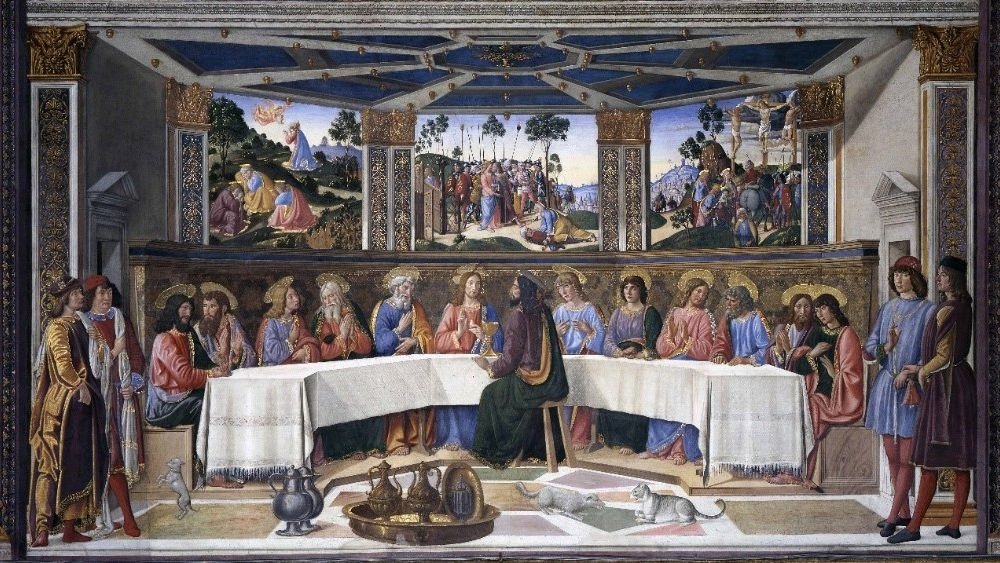 Holy Communion (Feast of Foot Washing)
1. “When he had finished eating, Jesus took off his outer clothing, wrapped a towel around his waist and poured water into a bowl and began washing his disciples’ feet and drying them with the towel that had been wrapped around him. (Jn 13:4-5).
Introduction
A comparison of the Lord's Supper with the meal of Abraham.
An example of a similar event is found in Genesis: “It will be good if some water is brought and you will be able to wash your feet; and take shelter under the tree; and I am going to prepare a small meal for you and you will feel refreshed, and you can continue on your way after that.” (Gen 18:4–5)
What Abraham gave to the three angels, Jesus extended to His twelve apostles: the carriers of truth who had been appointed to preach faith in the Trinity throughout the world. He made Himself their servant by crouching down and washing their feet in a gesture of deep humility. Oh, how deep is this unfathomable humility! Oh, how great is this unimaginable condescension! He, before whom angels worship in Heaven, stoops down to the feet of fishermen; he who is feared by the angels, bows down before the lowly.
As a result of this, Peter said, “You shall not wash my feet forever!” (Jn 13:8). This was a total denial of Peter being willing to let Jesus wash his feet. He couldn’t handle the thought of God himself getting down and washing his feet! Then Jesus replied to Peter, “If I don’t wash you”, this is the same as saying, “If you deny me washing you”, then “you will have no part with me” (Jn 13:8). His message here is you have no relationship with me! Importantly, no one can be connected to Jesus unless they have been washed by baptism, through confession, through penance.
After washing their feet (Jn 13:12), he let them rest under the tree symbolizing Him. “I sat down under his shadow with great delight, and his fruit" (referring to his body and blood) "was as sweet to my palate” (Song 2:3). When he served each of them a morsel of bread from that table, this was to refresh their hearts so they might endure the trials they would soon encounter. “As they were eating, Jesus took the bread, blessed it, and broke it” (Mt 26:26). By breaking it, He was signifying that His “breaking” would occur only by His desire. He first blessed it because He had infused the nature He assumed with divine power through His father and His holy spirit. In reference to Matthew 26:26, we can interpret Christ's words "Take, eat, this is my body" (Mt 26:26) as meaning; "He blessed it" — "This is my body." After breaking the bread, He distributed it to His disciples, saying "Eat!" — repeating "This is my body."I. Allegorical Discourse
3. Let us examine the symbolic significance of the supper, the garments, and the towel, in addition to the water, the basin, and the feet of the disciples.
The meal represents the Father's glory; taking off the robes signifies turning away from majesty; the towel stands for the holy flesh; water means the loss of blood or giving of grace; basin stands for hearts of disciples; feet stand for disciples' love.
Many people were invited to a great dinner. (Luke 14:16). The feast will be an incredible, grand display of God's divine splendor and majesty, filled with His abundant glory, and will bring two-fold glory. However, even though the invitation is extended to many people, few respond to it, because “What is crooked cannot be made straight. And what is lacking cannot be counted.” (Ecclesiastes 1:15). There are many people who have rejected the invitation to the “supper of life,” and instead have relied on worldly or temporal things (fools). Just as a pig prefers to lie down in a muddy hole than on a nice soft bed, so many of these people prefer the rubbish of the world over the divine banquet. Therefore, Christ gets up from His joyous banquet, so that He may redeem those people from their earthly and filthy condition.
He took off his "outer clothing." Significantly, Jesus modelled taking off His clothing on four separate occasions. He took off His coat at the supper and then again at the post-supper. He was stripped of His coat, but he was clothed at the pillar then also during the mockery of the soldiers. There is no record of Him being stripped by Herod or being given clothes again after He was stripped on the cross.
The first part of laying away relates to the apostles, whom he left for a time but later showed them to himself again. The second part has to do with those who came to the church at Pentecost, and eventually to those who have come gradually through the ages. The third part is for those who will come at the end of time. The fourth part concerns our present-age of wickedness, which will not be approached by the Church again. Today, in some churches, they practice the second and fourth parts of what it means to lay aside their garments, when they strip everything off of the altar, before anointing it with water and wine, and then hit it with branches that look like whips. Laying aside your garment is the act of annihilating yourself completely; after washing, Jesus put them (the garments) back on him as he returned to his Father from whom he originally came, fulfilling all of the obedience.
The blessed Sebastian's Passion describes an account of a king's gold ring that had a precious stone set within and meaning just as much to him as himself. When the ring slipped from his finger into the sewer, the king experienced an overwhelming feeling of sadness. Even after having tried to find someone who could help him get his ring, he decided to change out of his royal clothing, put on sackcloth, descend into the sewer, and search for his ring. After spending considerable time searching, the king found the ring and was so happy to have found it that he took the ring back to his palace.
The king (representative of Jesus Christ) represents God, and the ring (represents mankind) is representative of mankind; the stone set in the ring (represents the soul of man). That stone (the soul) was lost (through earthly joy) and separated from God through the lost soul of man known as Adam, who went to hell through the disobedience (of Adam) which caused God the Father much sorrow, so that, God the Father sent Jesus Christ to seek (through the angelic and human worlds) for someone who could recover the ring (for He did not find anyone) so that He might redeem (the whole earth) man. Therefore, He gave up His robes and humbling Himself took upon Himself sackcloth (for thirty-three years), and searched for a ring (whose soul was lost), and when He found it, He took all (man) from hell, and He gave them back the gift of eternal happiness, which was originally given to them when they were created.
4. "And having taken a towel, he girded himself.” The towel, symbolising our human nature, was taken from the immaculate body of the Virgin Mary. This coincides with what is said in the book of Ezekiel, "And the Lord said to the man clothed in fine linen, Go into the wheelwork, which is under the cherubim" (Ezk 10:2). The wheel, which is to be returned to its origin; refers to human nature; and that it is said, "For you are dust, and to dust shall you return" (Gen 3:19). The expression "in the midst," refers to the ends of time (beginning and the end).
Recognizing human nature as having three distinctive features: that our birth is impure, that we suffer through our journeys in life (akin to a pilgrimage), and that we will all die at some point, the man in linen represents Jesus Christ, to whom the Virgin Mary gave him a linen robe; therefore, He was not conceived through an impure birth because He was conceived through a pure Virgin by the Holy Spirit, He did not die due to the degradation of body according to Acts 15:10 (in disregard of the Gregorian Calendar), Jesus arrived at earth “in the center” of our pilgrims, being a poor exiled wanderer here on earth without a permanent home.
"Nehemiah 2:14 says "...There was no room for my mount to pass along with me:—or to ride in the saddle (v. 13)." The name Nehemiah, which means "consolation of the Lord," serves as a type of Christ, the consolation of God's people during times of desolation. In this context, Isaiah expresses God as being "A refuge to the poor, A refuge for the needy in their distress, A shelter from the storm, And a shade from the heat (Is 25:4)." The Lord is our consolation in human difficulties, the tempest of the diabolical temptation, and the burning heat of lust and vanity; and the Lord's mount represents mankind, upon which the Lord has secured his divine seat." This creature - represented by a wounded, human being - had no place to rest in the world because he was without a home due to having nowhere to lay his head - as he is stated to have done in Matthew 8:20 and Luke 9:58. The only place of rest for him was on the cross when he bowed his head and surrendered his spirit, as is written in John 19:30.In the same way, he came to the wheel underneath the cherubim, to the wheel that was made lower than angels (cf Heb 2:7), when he took the towel and wrapped it. Wearing this flesh, he wore the veil of humility, and therefore the humility of the Redeemer must have been equally as great as the pride of the betrayer.
5. “He then poured water into the basin.” Commentary: He shed his blood upon the ground to purify the marks left by believers, tainted by worldly transgressions.
Observing that the basin (from its resemblance to a "concave" shape of an "open rimmed" bowl) holds out from one side, therefore the basin was made for washing, so too the apostles' hearts through their humility and devotion as the basin is meant to hold water to wash feet (those who are devoted) can be said to have open rim; thus, the term "pelvis" has been appropriated (from the Latin word for basin) to refer to a basin (the Latin word) that would (having been filled with water) cause devout feet to no longer be dirty because of the water of grace with which God has filled the hearts of the apostles, and today He continues to fill with grace daily so that all who are devoted to Christ may have their feet (which symbolize their affections) cleansed of dirt. This is also evident in Job's words: "I washed my feet in milk" – milk is the richness of the soul's devotion and through the devotion of Job (the "grieving one") he makes clean his affections as well as the thoughts of his heart.
Using the towel he wrapped around himself, he dried the Lord's body, because the agony and suffering endured by the Lord serve as our purification. As we dry ourselves with this towel, we are called to wash from ourselves all the sweat we have worked for and all the blood that has been shed in our struggles, and for all your examples of patience through every trial, and thereby may ultimately share in his glory with joy. May He give this to us with his eternal blessing. Amen.
In the Sunday Sermon titled "The Lord’s Supper," Saint Anthony of Padua, a Doctor of the Church, articulates profound insights.
And he wiped them with the towel with which he was girded, because all the suffering and passion of the Lord’s body is our purification. With this towel we must wipe away the sweat of our labor and the blood of our suffering, taking in every tribulation the example of his patience, so that we may rejoice with him in his glory. May he grant this, he who is blessed forever. Amen.
(From the Sunday Sermon “The Lord’s Supper” by Saint Anthony of Padua, Doctor of the Church)