
 Italiano
 Español
 Français
 Deutsch
 Nederlands
 Polski
 Português
 Português do Brasil
 Pусский
 日本語
日本語 简体中文
简体中文 한국어
한국어 Bahasa Indonesia
This is an independent website and it'is not affiliated with or endorsed by the Vatican Museums.


Rome's Four Holy Doors: Sealed Until the 2033 Jubilee
 Rome's Four Holy Doors After the 2025 Jubilee
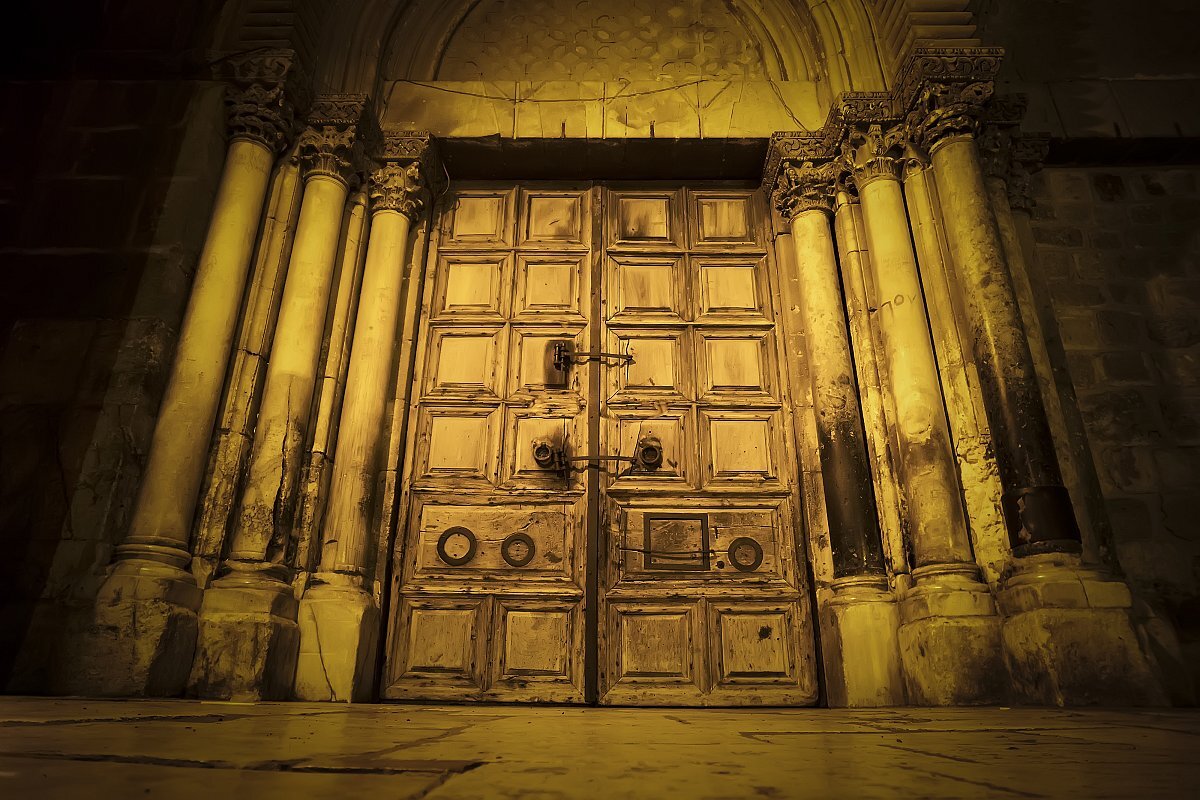
Sixteen bronze panels make up the Holy Door at St. Peter's. They tell salvation history in scenes, top-left to bottom-right. The last panel, in the bottom right corner, shows Pope Pius XII opening this same door for the 1950 Jubilee. The door, in other words, has a panel of itself being opened. That's the kind of detail that happens when an institution measures time in centuries.
The door is bricked shut again, as of the first week of January 2026. So are the other three: St. John Lateran, St. Mary Major, and St. Paul Outside the Walls. The next time they open is the 2033 Extraordinary Jubilee, announced by Pope Leo XIV in November 2025. Here is what that means and what's worth knowing about each.
What a Holy Door actually is
Porta Sancta. A specific door at each of the four papal basilicas in Rome, opened only during a Jubilee Year. Catholic tradition holds that passing through one during a Jubilee, with proper disposition, qualifies the pilgrim for a plenary indulgence: the full remission of temporal punishment for sins already forgiven. The theological mechanics are old and specific. The practical effect is that during a Jubilee, millions of people queue to walk through.
Outside of a Jubilee, the doors are physically sealed. The mechanism is straightforward: a brick wall is built behind the bronze door from inside the basilica. The seal is broken ceremonially at the opening of each Jubilee by the pope, who uses a hammer (in earlier centuries, a literal masonry hammer; the modern ritual is more symbolic), and resealed at the close. So when you stand outside one of these doors in 2026, you're looking at decorative bronze, and behind it, brickwork.
This tradition goes back to 1500, when Pope Alexander VI Borgia institutionalized the ritual. The current bronze monumental doors are all 20th century. Before that the doors were typically wooden, and the original Jubilee "doors" were simply bricked portals reopened by demolition every twenty-five years.
The four basilicas, briefly
St. Peter's Basilica holds the famous one. The Holy Door is the rightmost of the five bronze doors on the basilica's facade. The other four are the central doors by Antonio Filarete (1455), and the Door of Death on the far left by Giacomo Manzù (1964), through which the coffins of deceased popes are carried out.
St. John Lateran is the cathedral of the Bishop of Rome (a role held by the pope) and the oldest of the four papal basilicas. Its Holy Door was restored for the 2000 Great Jubilee. In Catholic ecclesiology, St. John Lateran outranks St. Peter's despite being less visited; it is the actual mother church of the Roman Catholic world.
St. Mary Major sits on Esquiline Hill, east of Termini. This is the basilica where Pope Francis was buried in April 2025, the first pope laid to rest outside the Vatican in over a century. Its Holy Door also dates from preparations for the 2000 Jubilee, commissioned by John Paul II. The basilica's visitor numbers tripled after Francis's burial; the Holy Door now sees crowds it didn't see during the Jubilee itself.
St. Paul Outside the Walls is the southernmost and least-visited of the four. Its Holy Door has a quirk: since 1967, it has not been bricked shut between Jubilees the way the other three are. A bronze door, but no wall behind it. The historical reason is unclear; the practical effect is that this is the only one of the four where you can see what was, in past centuries, hidden behind the brickwork.
The St. Peter's door, closer up
The bronze door you see today was installed in 1949. Vico Consorti, a sculptor from Siena, designed it. The casting was done by the Marinelli foundry in Florence using the lost-wax method, the same technique used since the Renaissance. It replaced a wooden door from 1748, commissioned by Pope Benedict XIV, which had decayed beyond repair.
The commissioning story is more interesting than the door's standard description usually allows. Father Ludwig Kaas, then director of St. Peter's administration, requested it. The funding came from the Diocese of Basel in Switzerland, as a gift of thanks to God for the country having been spared from the Second World War. The bishop who proposed it, Franz Von Streng, framed it explicitly as a postwar gesture. A bronze masterpiece at the heart of Catholicism, paid for by a Swiss diocese as war-survival gratitude. Not many works of public Catholic art have that provenance.
The sixteen panels (arranged four by four) are divided into groups by the coats of arms of popes who celebrated Jubilees. All depict scenes from salvation history except one: the bottom right shows Pope Pius XII opening this door on December 24, 1949, with a stylized crowd behind him. Consorti made five monumental doors in his career; the nickname "Vico of the Door" stuck.
A Latin inscription at the bottom names Pius XII as commissioner and frames the door as a source from which "the abundant waters of divine grace may flow." That's verbatim; the inscription's there if you want to read it slowly.
The 2025 cycle: opened by Francis, closed by Leo
Pope Francis opened the St. Peter's Holy Door on December 24, 2024, beginning the 2025 Jubilee. He opened the other three over the following days. The opening of the St. Peter's door is, by tradition, the formal start of a Jubilee.
Pope Leo XIV closed the doors in early January 2026, after Francis's death the previous April. This made the 2025 Jubilee only the second in history to be opened by one pope and closed by another. The first such case was 1700, when Innocent XII opened the Holy Year in December 1699 and Clement XI closed it at the end of 1700. The gap between those two occurrences is 325 years. Patterns of this length are not common in any institution.
The closing ritual involved bricking the doors shut from the inside. The materials used are real masonry; this is not symbolic. The next opening will require actual demolition.
The next opening: the 2033 Extraordinary Jubilee
The doors are not waiting until the next ordinary Jubilee in 2050. In November 2025, during a visit to Istanbul for the 1,700th anniversary of the Council of Nicaea, Pope Leo XIV announced an Extraordinary Jubilee for 2033: the Holy Year of Redemption, marking the 2,000th anniversary of Christ's death and resurrection. The announcement was reaffirmed at the closing of the 2025 Jubilee on January 6, 2026.
Extraordinary Jubilees can be called outside the 25-year cycle to mark specific anniversaries. The most recent before 2033 was the Jubilee of Mercy in 2015-2016, called by Pope Francis on March 13, 2015. That Holy Door opened on December 8, 2015 (Feast of the Immaculate Conception) and closed November 20, 2016. The same opening-the-doors pattern is expected for 2033.
So the realistic next time the four Holy Doors open in Rome is late 2032 or early 2033. Seven years, not twenty-four. Our 2033 Jubilee guide covers the announcement in detail, including the Jerusalem-and-Holy-Land emphasis that distinguishes this Jubilee from the 2025 one.
Visiting the four doors now
You can still see all four from outside. They're public-facing, well-lit, and free to view.
At St. Peter's, the Holy Door is in the portico of the basilica's facade, the rightmost of the five. Enter St. Peter's Square through the main approach (Piazza Pia, now pedestrianized; see our walking guide to refurbished Rome for the route). The basilica is open to visitors year-round at no charge. If you're also visiting the Vatican Museums, book a skip-the-line tour; the standalone lines for both attractions remain long even post-Jubilee.
At St. John Lateran, the Holy Door is one of five on the facade facing Piazza San Giovanni in Laterano. The square itself was repaved as part of the Jubilee infrastructure work. The basilica is in central Rome, well-connected by Metro Line A (San Giovanni stop, recently renovated).
At St. Mary Major, the Holy Door is on the side, not the main facade. While you're there, the tomb of Pope Francis is in a side chapel; this has become the basilica's biggest draw post-2025. Both can be visited in the same trip.
At St. Paul Outside the Walls, the door is in the basilica's distinctive 19th-century reconstruction. This is the basilica that burned in 1823 and was rebuilt; it feels younger than the others because much of it is. Reach it by Metro Line B (San Paolo stop). The basilica is roughly 2 km south of the historic center, often skipped by short-itinerary visitors; the lack of crowds is a feature.
One detail worth keeping in mind
The mechanics of the Holy Door, both ritually and physically, are unusual at this scale. There are not many things in modern life that are deliberately, ceremonially sealed up for years at a stretch. The 2033 announcement is, in this sense, an unusual modern phenomenon: a known future date for an institutional ritual that involves actual masonry work, planned seven years out.
For the broader picture of what closed and what changed when the Jubilee ended, our post-Jubilee overview covers the rest.