

 Italiano
 English
 Español
 Français
 Nederlands
 Polski
 Português
 Português do Brasil
 Pусский
 日本語
日本語 简体中文
简体中文 한국어
한국어 Bahasa Indonesia
Dies ist eine unabhängige Website, die weder mit den Vatikanischen Museen verbunden ist noch von diesen unterstützt wird.


Michelangelos „Jüngstes Gericht“ in der Sixtinischen Kapelle wird umfassend restauriert
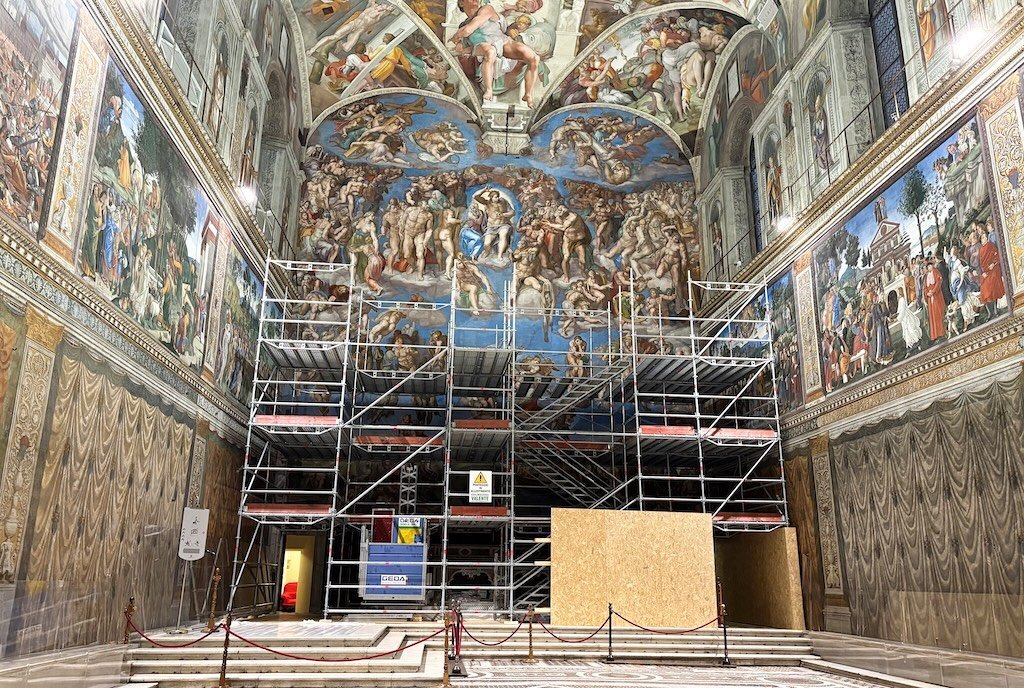 Die Sixtinische Kapelle: Michelangelos „Das Jüngste Gericht“ wird derzeit umfassend restauriert
Restaurierung von Michelangelos „Jüngstem Gericht“
Das monumentale Fresko „Das Jüngste Gericht“ (an der Altarwand der Sixtinischen Kapelle) wird derzeit einer außergewöhnlichen Konservierungsmaßnahme unterzogen, um Oberflächenablagerungen zu entfernen und die von Michelangelo beabsichtigten Farb- und Lichtwerte wiederherzustellen. Etwa drei Monate lang wird dieses Meisterwerk Michelangelos einer Reinigung unterzogen.
Wiederherstellung der ursprünglichen Pracht
Dieses Projekt soll die formale und expressive Komplexität des Gemäldes vollständig wiederherstellen und erneut jene Faszination hervorrufen, die vor dreißig Jahren bei der großen Restaurierung im 20. Jahrhundert zu spüren war. Diese fand vor nicht viel mehr als dreißig Jahren statt.
Die Kapelle bleibt für Besucher geöffnet
Obwohl die Vorbereitungen für das Gerüst bereits begonnen haben, bleibt die Sixtinische Kapelle weiterhin geöffnet und heißt Gläubige und Besucher willkommen. Die Reinigung findet unter einem hochauflösenden Bildschirm statt, auf dem ein Bild des Jüngsten Gerichts zu sehen ist, das von Restauratoren des Labors für Gemälde- und Holzrestaurierung der Vatikanischen Museen durchgeführt wird.
Barbara Jatta über dreißig Jahre Konservierung
Barbara Jatta, Direktorin der Vatikanischen Museen und des Kulturerbes: „Etwa dreißig Jahre nach der letzten Konservierungsmaßnahme am Jüngsten Gericht in der Sixtinischen Kapelle, die 1994 unter der Leitung von Generaldirektor Carlo Pietrangeli und unter Mitwirkung von Gianluigi Colalucci, Chefkonservator der Gemälde der Vatikanischen Museen, abgeschlossen wurde, wird ein spezielles Instandhaltungsprojekt beginnen. Es soll drei Monate dauern, dieses Meisterwerk aus Michelangelos Reifezeit zu restaurieren.“
Die Geschichte von Michelangelos Auftrag
Fabrizio Biferali, Kurator der Abteilung für Kunst des 15. und 16. Jahrhunderts, betonte, dass Papst Clemens VII. 1533 Michelangelo Buonarroti beauftragte, das Jüngste Gericht an der Altarwand der Sixtinischen Kapelle zu malen. Er erklärte, dass das Projekt „erst unter dem neuen Papst Paul III. begonnen wurde, der den toskanischen Künstler zum supremum architectum, sculptorem et pictorem Apostolic Palace ernannte und ihn von früheren Verträgen bezüglich des Grabes von Julius II. befreite, damit er sich voll und ganz auf das Projekt in der Sixtinischen Kapelle konzentrieren konnte. Michelangelo begann im Sommer 1536 mit der Malerei des Bildes und vollendete es nach umfangreichen Arbeiten (auf einer Fläche von etwa 180 Quadratmetern mit 391 Figuren) im Herbst 1541. Am 31. Oktober desselben Jahres konnte Papst Paul III. vor diesem großartigen Gemälde, das, wie Giorgio Vasari bemerkte, „ganz Rom mit Ehrfurcht und Staunen erfüllte“, eine feierliche Vesper zelebrieren.
Die technische Herausforderung der Konservierung
Paolo Violini ist der derzeitige Laborleiter für die Restaurierung von Gemälden und Holzwerkstoffen. „Wir führen derzeit gezielte Wartungsarbeiten am Jüngsten Gericht durch, da sich hier ein weißlicher Belag gebildet hat, der durch Ablagerungen von Mikropartikeln aus der Luft auf Fremdkörpern entstanden ist, die durch Luftströmungen hereingetragen wurden. Dieser Belag hat im Laufe der Zeit den Kontrast zwischen Licht und Schatten verringert und die ursprünglichen Farben des Freskos vereinheitlicht.“
Eine gemeinsame Anstrengung
Aus diesem Grund musste das Restaurierungslabor einen umfassenden Plan zur vorbeugenden Wartung für die Durchführung dekorativer Komplexe erstellen; ein solcher Plan umfasst das systematische Abwischen aller Arten von Ablagerungen, die sich dort über mehrere Jahre angesammelt haben.“
An dieser außergewöhnlichen Instandhaltungsmaßnahme sind auch das Wissenschaftliche Forschungskabinett, das Büro des Konservators und das Fotolabor beteiligt, was nur dank der großzügigen Unterstützung der Florida Chapter Patrons of Arts in Vatican Museums möglich ist.