

 Italiano
 English
 Español
 Deutsch
 Nederlands
 Polski
 Português
 Português do Brasil
 Pусский
 日本語
日本語 简体中文
简体中文 한국어
한국어 Bahasa Indonesia
Ce site web est indépendant ; il n'est ni affilié aux Musées du Vatican, ni approuvé par ceux-ci.


Le Jugement dernier de Michel-Ange dans la chapelle Sixtine fait l'objet d'une restauration complète
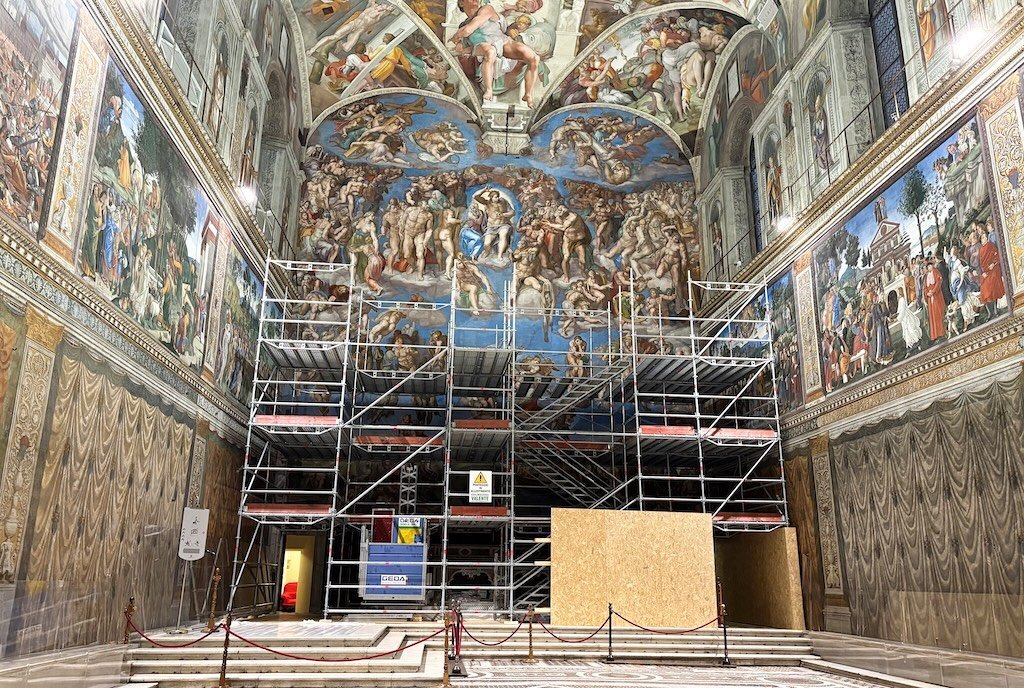 La chapelle Sixtine : « Le Jugement dernier » de Michel-Ange fait actuellement l'objet d'une restauration complète
Restauration du Jugement dernier de Michel-Ange
La fresque monumentale du Jugement dernier (sur le mur de l'autel de la chapelle Sixtine) fait actuellement l'objet d'un entretien extraordinaire visant à éliminer les dépôts superficiels et à restaurer les valeurs chromatiques et lumineuses voulues par Michel-Ange. Pendant environ trois mois, ce chef-d'œuvre de Michel-Ange fera l'objet d'une intervention de nettoyage.
Restaurer la splendeur d'origine
Ce projet permettra de retrouver toute la complexité formelle et expressive du tableau, rendant possible une fois de plus l'émerveillement qui avait été ressenti lors de la grande restauration du XXe siècle, il y a tout juste trente ans. Une restauration qui a eu lieu il y a un peu plus de trente ans.
La chapelle reste ouverte aux visiteurs
Même si les préparatifs pour l'échafaudage ont déjà commencé, la chapelle Sixtine restera ouverte et continuera d'accueillir les fidèles et les visiteurs. Le nettoyage se déroulera sous un écran haute définition sur lequel sera diffusée une image du Jugement dernier réalisée par les restaurateurs du Laboratoire de restauration des peintures et des matériaux en bois des Musées du Vatican.
Barbara Jatta sur trente ans de conservation
Barbara Jatta, directrice des musées du Vatican et du patrimoine culturel : « Environ trente ans après la dernière intervention de conservation sur le Jugement dernier de la chapelle Sixtine, achevée en 1994 sous la direction du directeur général Carlo Pietrangeli et réalisée par Gianluigi Colalucci, restaurateur en chef des peintures des musées du Vatican, un projet d'entretien spécial va démarrer. Il devrait durer trois mois sur ce chef-d'œuvre de la période de maturité de Michel-Ange. »
L'histoire de la commande de Michel-Ange
Fabrizio Biferali, conservateur du département d'art des XVe et XVIe siècles, a souligné qu'en 1533, le pape Clément VII avait chargé Michel-Ange Buonarroti de peindre le Jugement dernier sur le mur de l'autel de la chapelle Sixtine. Il a expliqué que le projet n'avait été lancé « que sous le nouveau pontife Paul III, qui a nommé l'artiste toscan au poste de supremum architectum, sculptorem et pictorem Apostolic Palace, le libérant ainsi de ses anciens contrats concernant le tombeau de Jules II afin qu'il puisse se concentrer pleinement sur l'entreprise de la Chapelle Sixtine. Michel-Ange a commencé à peindre la scène à l'été 1536 et, après un travail considérable (environ 180 mètres carrés comprenant 391 personnages), l'a achevée à l'automne 1541. Le 31 octobre de cette année-là, le pape Paul III a pu célébrer les vêpres solennelles devant ce grand tableau qui, comme l'a noté Giorgio Vasari, « a rempli toute Rome d'admiration et d'émerveillement ».
Le défi technique de l'entretien
Paolo Violini est l'actuel chef restaurateur du laboratoire de restauration des peintures et des matériaux en bois. « Nous effectuons actuellement un entretien ciblé du Jugement dernier, car c'est là qu'un film blanchâtre général - formé par le dépôt de microparticules en suspension dans l'air sur des matières étrangères apportées par les courants d'air - a réduit le contraste entre la lumière et l'ombre et homogénéisé les couleurs d'origine de la fresque au fil du temps. »
Un effort collaboratif
Cela a obligé le laboratoire de restauration à élaborer un plan global d'entretien préventif pour la réalisation de complexes décoratifs ; ce plan prévoit notamment d'essuyer systématiquement tous les types de dépôts qui se sont accumulés au fil des ans.
Cette intervention d'entretien extraordinaire implique également le Cabinet de recherche scientifique, le Bureau du conservateur et le Laboratoire photographique, grâce à l'aide généreuse des mécènes de la section de Floride des Amis des Musées du Vatican.