 Italiano
 Español
 Français
 Deutsch
 Nederlands
 Polski
 Português
 Português do Brasil
 Pусский
 日本語
日本語 简体中文
简体中文 한국어
한국어 Bahasa Indonesia
This is an independent website and it'is not affiliated with or endorsed by the Vatican Museums.


2025 Anniversary: A Year from Pope Francis to Pope Leo XIV
The year 2025 will be remembered as significant, characterized by the passing of Pope Francis and the subsequent election of Pope Leo XIV during the Jubilee. This Holy Year, which is dedicated to hope, commenced under one Pope and is scheduled to conclude on January 6 with another—a truly exceptional occurrence. Conversely, the year also witnessed an escalation of international geopolitical tensions and an increase in the "fragments" that the previous two Popes referred to as constituting the "Third World War.
The Entirety of the World Converges Upon Rome
During the Holy Year, over 30 million pilgrims from across the globe visited Rome to partake in daily celebrations, in addition to more than 30 special events tailored to various sectors of the Church and society.
Amid the celebration and optimism of the Jubilee, the world also observed the hospitalization of Pope Francis at the Gemelli Polyclinic on February 14, followed by his passing on April 21 and the subsequent funeral held five days later. The funeral ceremony for the Argentine Pope drew an attendance of over 250,000 individuals, while nearly double that number came to pay their respects as he lay in state within St. Peter’s Basilica. While he was hospitalized, many individuals gathered to recite the evening Rosary for the Pope's well-being in St. Peter’s Square, while others maintained a prayerful vigil in the courtyard of the hospital.
The Hospitalization of Pope Francis
At the beginning of 2025, Pope Francis commenced the new year by delivering an Angelus appeal denouncing “inhuman” warfare and conveying his condolences for mothers who have suffered the loss of their children due to violence. Subsequently, in mid-February, the Argentine Pope was admitted to the hospital for what was initially thought to be a routine case of bronchitis; however, it was later determined to be a polymicrobial infection characterized by multiple crises and gradual improvements.
Nevertheless, in spite of his delicate health, the Pope persisted in his engagements over the ensuing weeks, which included general and Jubilee audiences, meetings held both in the morning and afternoon, as well as evening telephone conversations with the sole Catholic parish located in Gaza.
He further announced two notable appointments: Sister Simona Brambilla as Prefect of the Dicastery for Institutes of Consecrated Life and Societies of Apostolic Life on January 6, and Sister Raffaella Petrini as President of the Governorate of Vatican City State on February 15. These appointments mark a historic moment, as two women, both religious sisters, now lead significant ecclesiastical institutions for the first time.
Throughout the period of hospitalization, two particular instances stood out as especially significant: Pope Francis' poignant audio message, delivered in Spanish with a soft voice, expressing gratitude to the faithful for their prayers; and the sole photograph captured during that time, depicting the Pope in a hospital gown and purple stole within the small chapel on the tenth floor.
A Concluding Farewell
On March 22, an announcement was made by doctors regarding the discharge of Pope Francis from the hospital. The subsequent day, he appeared publicly for the first time from a balcony at the Gemelli. Following this, he commenced his journey back to the Vatican, which included a brief visit to the Basilica of St. Mary Major to pay homage to the image of Salus Populi Romani.
At that moment, it was inconceivable to anyone that the tomb within the Basilica would bear the name Franciscus, particularly after the Pope had made three public appearances: first in St. Peter’s Square during the Jubilee of the Sick; next during a visit to the tomb of St. Pius X and the statue of Pope Benedict XV; and finally, his last appearance for the Easter Urbi et Orbi—this being both his first following hospitalization and the final one of his life.
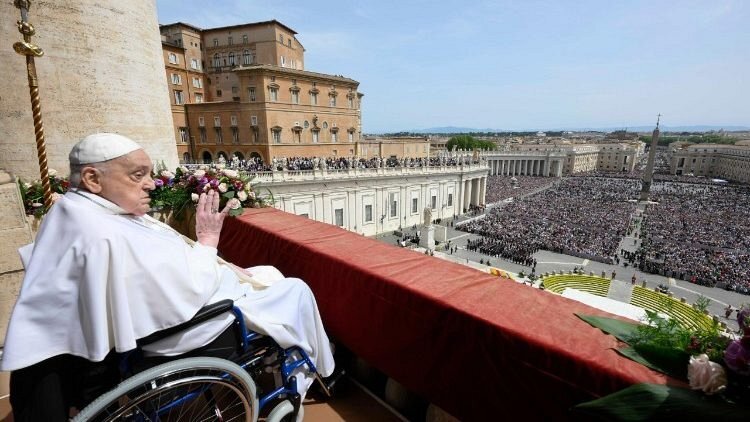 Pope Francis greets the crowds one last time during the Easter Urbi et Orbi blessing (VATICAN MEDIA Divisione Foto)
His words have been indelibly inscribed in the collective memory of all: “Thank you for bringing me back to the Square.”
The Pope Returned to the House of the Father
On Easter Monday at 9:50 a.m., the announcement made by Cardinal Camerlengo Kevin Joseph Farrell reverberated across the globe: “This morning, April 21, 2025, Pope Francis has returned to the house of the Father.” The cause of his passing was identified as a cerebral stroke, which was subsequently followed by cardiovascular collapse.
Thus commenced a new era for the Church. Following the Pope's passing, a sequence of long-standing traditions was initiated: the heartfelt tributes paid to the Pope at Casa Santa Marta and subsequently at St. Peter’s Basilica, after the body was relocated there; the sealing of the apartment within the Apostolic Palace; the ritual of closing the coffin; the dignified funeral; the procession traversing the streets of Rome; and the interment beneath a white marble monument at the Basilica of St. Mary Major.
Even now, the tomb of Pope Francis continues to attract a steady stream of pilgrims and visitors.
The Conclave and the Election of a New Pontiff
On April 27, the first Mass of the novemdiales was celebrated by Cardinal Secretary of State Pietro Parolin. The following day, approximately 180 cardinals convened for the initial General Congregation in preparation for the Conclave, including those from the most distant dioceses globally and those over eighty who do not possess voting rights.
May 7 marked the inaugural day of this time-honored tradition for electing a successor. It will be recorded in history as one of the swiftest conclaves, culminating in the election of Cardinal Robert Francis Prevost as the 267th Successor of St. Peter on May 8 during the fourth ballot.
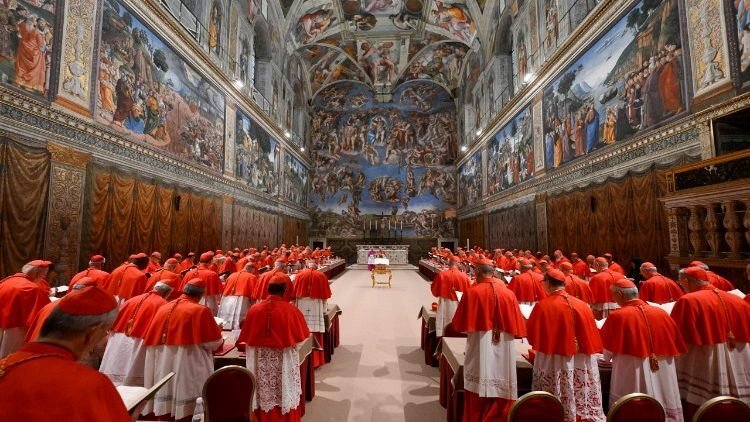 Inside the Sistine Chapel during the Conclave that elected Pope Leo XIV (@Vatican Media)
The first pope to come from the United States was born in Chicago 69 years earlier. He has spent more than two decades working in a Latin American country as a missionary, parish priest, catechist, and bishop, so he certainly brings with him “a Peruvian soul.”
Prevost is an Order of St. Augustine priest. He served two terms as Prior General of the Order. He has a degree in both Mathematics and Canon Law from the University of Minnesota, as well as an extensive background in the Roman Curia, having served as the Prefect of the Dicastery for Bishops.
A New Papacy Commences
The recently elected Pope adopted the name Leo XIV as a tribute to Pope Leo XIII, the author of Rerum Novarum, which signified the inception of the Church’s Social Doctrine.
Pope Leo began his first speech with a single word which was "Peace". He continues to use this word 10 times throughout the entire speeches. He will also use the phrase "a peaceful, unarmed and disarmed" to promote his papacy.
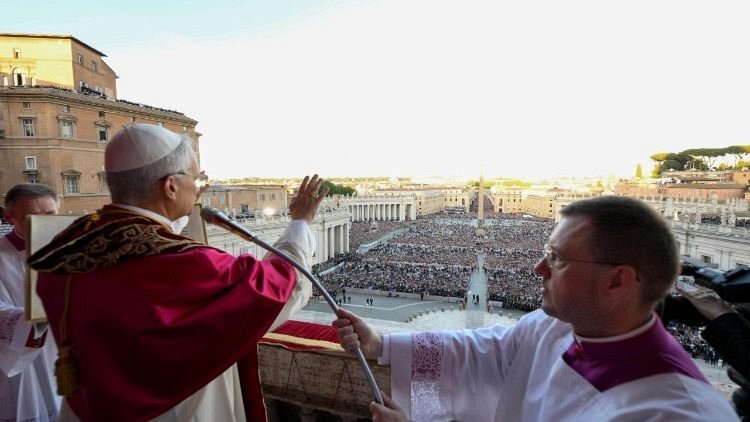 Newly elected Pope Leo greets the crowds from the central balcony of St. Peter's Basilica (@Vatican Media)
At the Sistine Chapel on the day after he was elected, the Pope expressed to the College of Cardinals another part of his vision: “Be will to not exist, and let Christ exist.”
Striving for Peace
The papacy of the first pope from the United States began on May 18 at Mass held in St Peter’s Square. Many pilgrims and dignitaries were in attendance from around the world for the inauguration of the new pope’s pontificate.
Pope Leo has been a supporter of peace since he became pope and has consistently asked the “great ones” on earth to “never again war”. On May 11, at the Loggia of Blessings, during his first Regina Caeli, he repeated that message.
Pope Francis held talks with the president of both Russia (Vladimir Putin) and Ukraine, (Volodymyr Zelensky) having met with Volodymyr Zelensky on three specific occasions including their second meeting in Castel Gandolfo, Italy where the pope reinstated a summer residence after 12 years; He has made 3 total visits to Castel Gandolfo, 2 were at Villa Barberini and 1 was at the newly opened museum in the Apostolic Palace.
Additionally, Pope Leo XIV has suggested that the Vatican could be used as a place for mediation and negotiation to help end the violence in Ukraine and to support diplomatic efforts (often done "behind-the-scenes") throughout all conflict areas.
Youth as the Central Figures of the Year 2025
On September 7th, Pope Leo honouring the memory of his fore-bearers by canonising two young saints, Carlo Acutis and Pier Giorgio Frassati Both canonisation ceremonies had originally been intended to coincide with the Youth Jubilee Jubilee of Youth and Jubilee of Adolescence; however, both of these were postponed at the time of Pope Francis' death.
The main event that happened during the first eight months of Pope Leo's papacy was a Jubilee for youth occurring from the 28th of July to the 3rd of August. This event brought more than 1,000,000 youth together from all over the world to participate in the vigil and Mass to be said by the Pope at Tor Vergata.
The Republic of Türkiye and the Lebanese Republic
In his first worldwide apostolic journey, Pope Leo visited Türkiye and Lebanon between November 27 and December 2. The purpose of this trip to Turkey was to celebrate the 1700th anniversary of the Council of Nicaea. While there, the Pope visited Ankara before going to Istanbul to meet with Bartholomew I, the Patriarch of Constantinople. He then travelled to Iznik where he held a memorial Mass on the shore of the lake for the remains of the Basilica of St. Neophytos, which was the site of the ecumenical council.
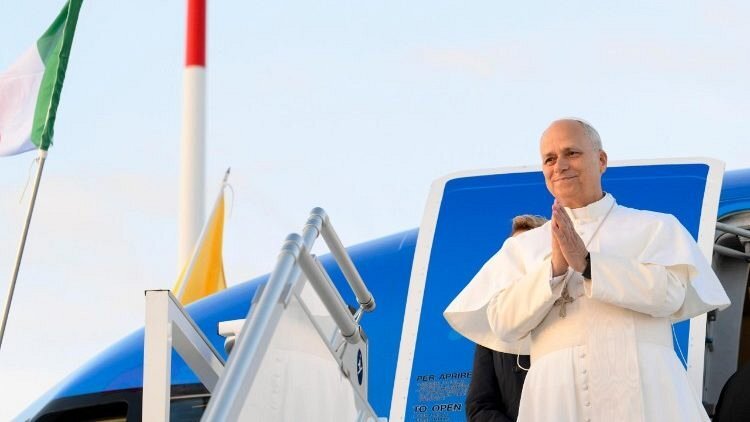 The Pope makes his first international apostolic journey (@VATICAN MEDIA)
The Pope visited the site of the 2020 Port of Beirut explosion, where he met and hugged both survivors from the blast and families of those who died in the attack. He also organized a 'mini World Youth Day' in Bkerké, which was attended by approximately 15,000 young people from the Lebanon and the surrounding area. He met with the leaders of Christian Churches and representatives from other minorities and prayed for peace with them. The Pope urged world leaders to stop fighting with one another and to put down their weapons.
Anticipating the Year 2026
On January 6, 2024, the Holy Year will come to an end with the closure of the Holy Door of St. Peter's Basilica after a year of special jubilee celebrations and events, as well as the Holy Doors of the other three papal basilicas having previously been closed: Santa Maria Maggiore (December 25), St. John Lateran (December 27), and St. Paul Outside the Walls (December 28).
An extraordinary consistory will be held on January 7 and 8, 2026 (Rome). The cardinals who arrive from various parts of the world will spend two days reflecting and praying. They will provide the Pope (Leo) with support and advice on how to govern the entire church (universal church) as well as promote listening, synodality, and unity and work to eliminate/conquer all forms of polarization.