
 Italiano
 Español
 Français
 Deutsch
 Nederlands
 Polski
 Português
 Português do Brasil
 Pусский
 日本語
日本語 简体中文
简体中文 한국어
한국어 Bahasa Indonesia
This is an independent website and it'is not affiliated with or endorsed by the Vatican Museums.


Pope Leo XIV: The Foundation of Education Is Inner Life, Solidarity, Love, and Hope
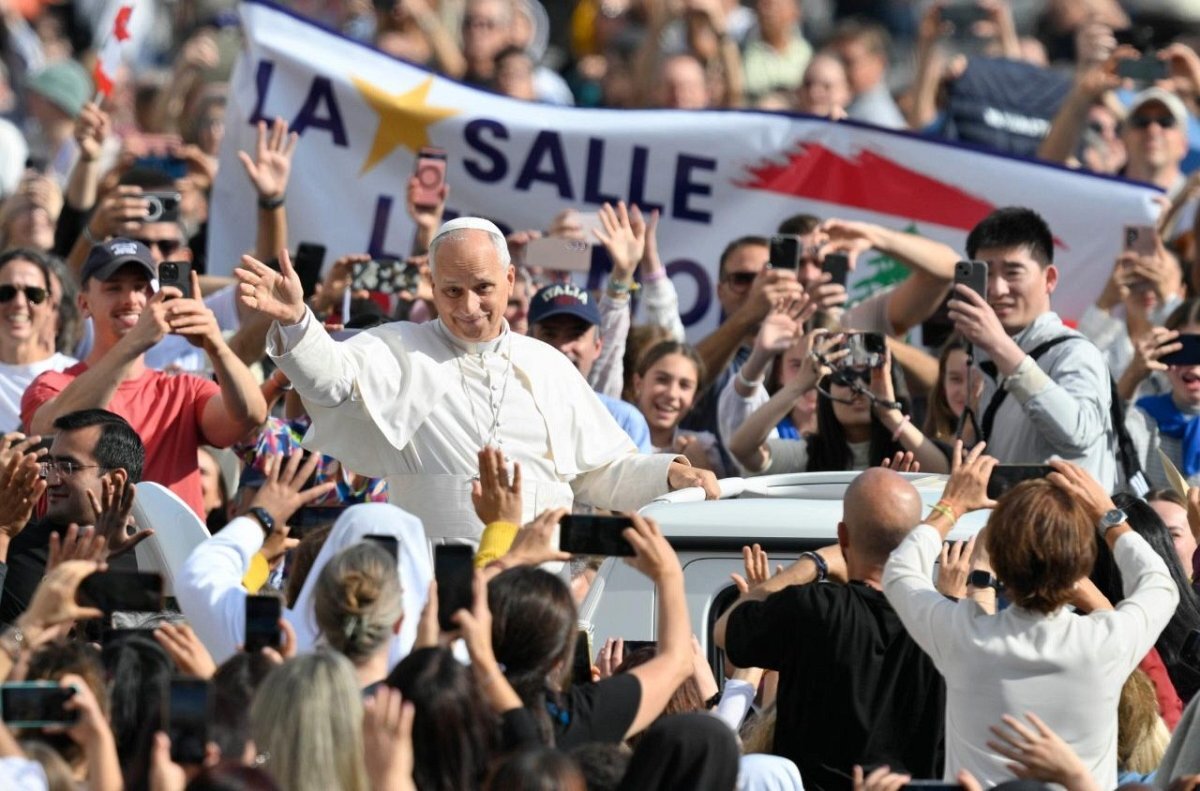 Pope: The foundation of education is inner life, solidarity, love and hope
The four cornerstones of Christian education
Pope Leo XIV based his address to teachers from all over the world who were gathered in St. Peter's Square for the Jubilee of Education on his experience as a teacher in an Augustinian Institution of Education.
According to the Augustinian Pope, the four fundamental elements of Saint Thomas Aquinas's doctrine—interior life, unity, love, and joy—serve as the essential cornerstones of Christian education.
The Pope mentioned several aspects of education in his speech that are "The key elements (of) Educational Practice;" the Holy Father states these elements should define the identity of "the Church… Mother and Teacher…of the many children and youth that you dedicate your time (and energy) to."
Profound human interaction
Using Saint Augustine's quote, which states: "'The voice of our words strikes the ear, but the True Teacher is in us '" as a basis, the Pope pointed out to his listeners that it is wrong to consider that solely eloquent speech and nicely decorated rooms, laboratories, and libraries can teach well.
He explained how an object or physical environment can be an instrument or tool; they have value, but the real teacher is inside of us. True comprehension does not come from sounds, buildings, or passageways; rather, true comprehension comes from 'the deep interaction between people, without which any form of education is ultimately doomed to fail.
Interiority
The Pope stressed that modern students need help finding their inner selves due to the huge number of superficial distractions in a world that is so dominated by screens and technology. The Educators' challenge was due to being tired and weighed down by bureaucratic responsibilities. They risk ignoring "The heart speaks to heart" (Cor ad Cor Loquitor), coined by Saint John Henry Newman, which is similar to St Augustine's call to "Return To Yourself, Within You Is The Truth".
According to the Pope, the idea behind these two ideas is that "education should be seen as a collaborative journey between teacher and student, with an awareness on both parties' parts that neither has made progress on that journey and that they both need to continue to look for answers to their inquiries, even once they have found some."
According to him, this very simple and cooperative group effort to create a learning experience for students and teachers has brought them closer together.
Unity
The theme of unity is most definitely an important one to the Pope, who has noted that his papal motto "in illo Uno unum est" (in the One We Are All One) reflects this principle; he also stated that "To find true unity, you must be joined together as a member of Christ's body with Him, the head, and we are all on a common pilgrimage of knowledge, thus we have a common source of unity."
The Holy Father stressed how this "togetherness" part of St. Augustine's writings is vital to education by being against being egocentric and being a motivation for individual growth.
Love
Addressing the third point regarding love, the Pope emphasized that "to teach, it is insufficient to merely share knowledge; love must also be present.
The cited statement of the speaker emphasizes that an integral aspect of teaching revolves around love and that one of the more serious problems for society is a decrease in valuing how significantly teachers and educators can influence communities through love.
Joy and the challenge of inner fragility
As love is the foundation of education, it's therefore that love is an essential part of how we educate—both in our words and in the compassion that we share through our work. Joy. Pope's final comments on joy were "truly the joy of your students, and you as an educator, will bring forth that joy deep within their hearts by providing them with your knowledge through a smile." It is then, according to the Pope, that an educator's responsibility to provide his/her students joy through the act of education will also include how the student receives joy with a smile from you.
He expressed his concern about the evidence of "widespread inner fragility at every age group" in today's schools. According to Pope Leo, "We must not turn a blind eye to these silent cries for assistance." He stressed the need to try to find their deepest roots.
He believes that AI has (technical/cold/standardised) knowledge may further distance disconnected students and lead to a situation where they think they don't need other people or (even worse) that they don't deserve to have connections with other people either.
Education as a path to unity in Christ
In terms of the educator's mission to offer their students the opportunity to have an authentic relationship with Christ, we know that the papal statement that the primary purpose of education is “to bring people together as one” — which is at the nucleus of the very heart of the Catholic/Christian education system — state that “we find unity as we are united again with the body of Christ: as we are connected together to the Head (Jesus) and companion on our journey of learning.”
Pope Francis said that the "dimension of togetherness" outlined in Saint Augustine's writings is essential in educational settings, as it serves as both a challenge to individualism and also an impetus for development. Love The third area addressed by the Pope was love. He indicated that "a teacher must love." The Pope provided examples of how love and education are interconnected, and that today we are facing many challenges that limit discernment about how important teachers and other educators have been and continue to be within our communities.
He emphasized that only when love is a part of teaching, and through this connection, will the act of teaching be completely fruitful; this includes teaching beyond content and creating a means of sharing love through graciousness. Happiness Finally, Pope Francis made mention of joy by stating that “as true teachers, they should have happy faces” and “their challenge is to inspire young people, so that they too can create happy faces in the hearts of others.”
Pope Leo expressed his anxiety and sadness over what he sees as a growing "epidemic of inner fragility" in schools and classrooms throughout the world. "We must not ignore this silent cry for help." "Rather, we must work to discover its root cause."
According to him, the “technical, standardized, and cold” characteristics of this new form of digital learning could further alienate an already isolated student body by communicating the message to the student’s mind that they don’t require other people for learning and/or that they are unworthy of them.
In this light, the Pope stated that the role of education is to connect people together as humans; that `the actual joy of education occurs because it is something human, an energy source that joins together many individuals into one.